How to calibrate a hygrometer
Every decision about your humidor rests on the hygrometer, and many read several points out. Here's how to find out how far, and what to do about it.
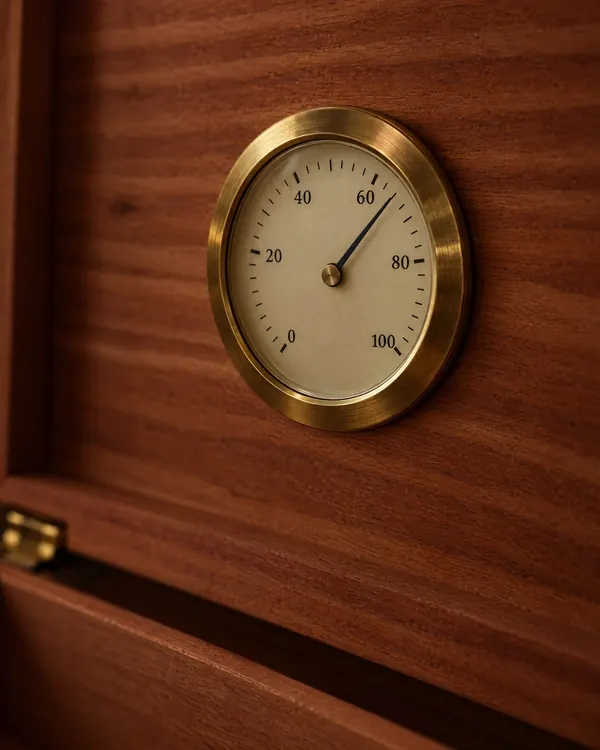
A hygrometer measures relative humidity, and it's the instrument the whole humidor depends on. The trouble is that many aren't very accurate. Testing one takes a day and costs almost nothing, and it tells you how much to trust every reading after.
How accurate are they?
- Typical consumer digital hygrometers: often ±5–7% RH, according to Vigilant.
- Dial (analogue) hygrometers: metal-spiral types can be ±5% even when calibrated; good synthetic-hair dials can do better than a cheap digital one.
- Bluetooth sensors: SensorPush quotes ±3% typical between 20% and 80% RH; Govee quotes ±3% for its H5075.
So "digital is always more accurate" isn't quite true. What matters is knowing your particular unit's error.
The calibration pack method
The simplest test uses a two-way humidity calibration kit, which holds a known 75% RH.
- Put the hygrometer and the pack in the sealed bag that comes with the kit.
- Leave it for at least 24 hours at room temperature (Boveda specifies about 19.5–23.5°C).
- Read the hygrometer without opening the bag. It should say 75%.
The salt test
The home-made version uses ordinary table salt, which in a sealed space holds the air at about 75% RH.
- Mix a small amount of table salt with just enough water to make a damp slurry. Tobacconist University suggests about half a cup of salt to a quarter cup of water; others use a bottle cap of damp salt.
- Seal the salt and the hygrometer together in a zip bag or airtight container, with the salt not touching the sensor.
- Leave it at a steady room temperature. Sources say anything from 8 to 24 hours; give it the full 24.
- Read the hygrometer through the bag. It should read 75%.
Boveda argues the home-made test is less reliable than a calibration pack because the result depends on the salt-to-water mix. It's still a useful check if you have nothing else.
Applying an offset
- If your hygrometer can be adjusted, set it to 75% while it's still in the test, then re-test to confirm.
- If it can't, note the difference and apply it to every reading. If it read 72%, it's 3 points low: a reading of 66% in the humidor is really 69%.
Write the offset and the date on a label on the hygrometer, or in your humidor records, so you don't have to remember it.
A rough second check
The damp-towel test (wrapping the hygrometer in a damp towel) should push it towards the top of its scale. It isn't accurate enough to calibrate with, but if a hygrometer barely moves, it's faulty.
How often
Boveda suggests every six months; Vigilant suggests once a year. Re-test after a hygrometer has been through 84% seasoning, too: SensorPush notes that long periods above 80% RH can temporarily push readings up by as much as 3%.
Sources
- Boveda: hygrometer calibration and on the home-made salt test
- Tobacconist University: Hygrometer FAQ
- Cigars International: How to calibrate a hygrometer
- Vigilant: How accurate is my hygrometer?
- Humidor Discount: Which type of hygrometer?
- SensorPush specifications; Govee H5075
Questions collectors ask
How accurate are cigar hygrometers?
Less than most people assume. Typical consumer digital units are quoted at ±3–7% RH, and simple dial hygrometers can be worse. Even good units are usually specified at about ±2–3%.
What should a hygrometer read in the salt test?
75% relative humidity. If it reads 72%, it's reading 3 points low, so add 3 to every reading (or adjust it, if it can be adjusted).
How often should I calibrate?
Boveda suggests every six months; others say once a year. Check sooner if readings suddenly look odd.