How to catalogue a cigar collection
What to write down for every box and every single, how to organise it, and how to make sure the records outlive your phone.
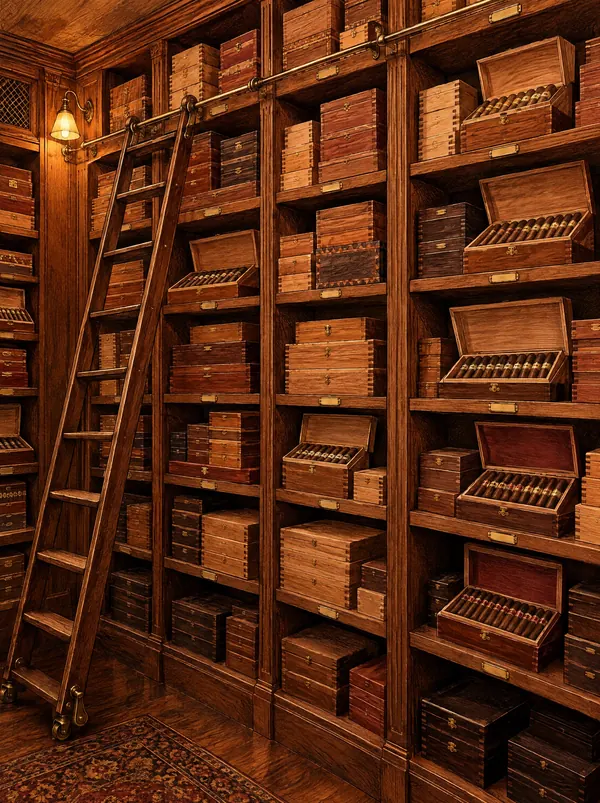
Most collections start with a handful of boxes and a good memory. A few years later there are boxes in two humidors, a tupperdor in a cupboard and loose cigars in a travel case, and nobody can say with confidence how old any of it is. A catalogue fixes that. It doesn't need to be elaborate; it needs to be consistent, and it needs to survive a new phone.
Start with the box code
If you record only one thing per box, make it the ink stamp on the underside or back: the factory code and the packing date, such as EL ABR 19. Copy it exactly as printed, including codes you don't recognise. That line dates the box, and the date is what everything else hangs on: its age today, when it's likely to be at its best, and how your notes on it change over the years. Our guide to Habanos box codes explains how to read each part.
What to record for every box
| Field | Why it matters |
|---|---|
| Brand, line and vitola | Identifies the cigar. Use the name on the band and box, for example a line's Robusto or No. 4. |
| Box code and date | Dates the box. Record it as stamped. |
| Count: bought and left | Tells you what's actually in the humidor, and how fast a box is going. |
| Box type | Slide-lid, cabinet, dress box or tubos. Useful for identification and for value. |
| Where it lives | Humidor and shelf or drawer, so you can find it without opening everything. |
| Date acquired and where from | Your provenance record. It matters if you ever pass a box on. |
| What you paid | A starting point for value, and a fact you won't remember in five years. |
| Warranty seal barcode | On boxes from 2009 onwards; note whether the Habanos online check matched. |
| Photos | The box, the stamp and the seal. A photo of the stamp settles any typo later. |
| Notes, dated | Each time you smoke one, so you can compare the same box across the years. |
Single cigars
Loose cigars are where records usually fall apart. Treat each group of singles as its own entry: what they are, how many, where they are kept and, if you know it, the code and date of the box they came from. Value them per cigar rather than per box. If singles came as gifts with no box, record that too; "undated" is still information.
Organise by humidor and shelf
A catalogue is most useful when it matches the physical layout. Give each humidor a name and record its range (Habanos recommends 65–70% relative humidity at 16–18°C; see our humidity and temperature guide). Then note which shelf or drawer each box sits on. When you move a box, move it in the catalogue at the same time.
It also pays to log humidor readings now and then. A line of readings over a season shows you far more than a single glance at a hygrometer, and it's the first thing you'll want if a box ever shows mould or a cracked wrapper.
Values, with the source attached
What a box is worth changes, and figures without a source are guesses. Record each value with where it came from (an auction result, a retail listing, what you paid or your own estimate) and the date. Label everything as an estimate. Totals per humidor and for the whole collection are useful for insurance conversations, but only if every figure behind them can be traced.
Keep the records safe
- Export regularly. Whatever you use, keep a CSV or backup file somewhere other than your phone: a computer, a cloud drive, an email to yourself.
- Prefer open formats. CSV opens in any spreadsheet; a JSON backup can be restored exactly.
- Be wary of tools that hold your data hostage. If an app can't export, the catalogue isn't really yours.
- Photograph the stamps. If a record is ever lost, a camera roll of box stamps lets you rebuild it in an evening.
A simple routine
- When a box arrives: photograph the stamp and seal, record it, and put it on a shelf you note down.
- When you smoke one: update the count and add a dated note.
- Once a month: log a humidity and temperature reading for each humidor.
- Once a quarter: export a backup and refresh any values you care about.
Questions collectors ask
What is the single most important thing to record for a cigar box?
The factory code and date stamped on the box, exactly as printed (for example EL ABR 19). It tells you when the box was packed, which is how collectors track how long a box has been resting.
Should I catalogue single cigars separately from boxes?
Yes. Record singles as their own entry with a count, and if you know the box they came from, note its code and date so they can be dated too.
Is a spreadsheet good enough?
For a few boxes, yes. Past a dozen or so, most collectors want box ages to update themselves, values with their sources, and photos attached, which is where a dedicated catalogue helps. Whatever you use, keep an export somewhere other than your phone.